Moms to moguls
Moms to moguls. Before they were millionaires, these women were working moms trying to put food on the table. From a makeup mogul to a former file clerk to a home design icon, each one has her own rags-to-riches story.
Showing posts with label sarah palin. Show all posts
Home » Posts filed under sarah palin
Age of celebrity first-time moms
Posted by Shazy on Sunday, May 8, 2011
Age of celebrity first-time moms
Age of celebrity first-time moms. They may have more kids now, but have you ever wondered how old some celebrities and public figures were when they had their first baby? Let's wish all these moms a happy Mother's Day! Celebrity Hair
Posted by Shazy on Tuesday, March 22, 2011
Celebrity Hair

Do you want a celebrity hairstyle? Here are all free pictures of Celebrity Hairstyles, find your favorite look that fit you the best.

Kate Winslet
Kate Winslet
Kate Winslet ditched her trademark wavy auburn locks for an extreme new platinum blond cut. The "Mildred Pierce" star also shared some intimate details about her newly single life. Check out these other ladies who had a hair do-over.

Ginnifer Goodwin
Ginnifer Goodwin
The "Big Love" actress and "He's Just Not That Into You" star hides her pixie cut under a fake mane while filming the hit HBO show. Find out how she makes sure her short coif won't get in the way of stellar roles. She dons a dowdy cover in an upcoming rom-com

Michelle Williams
Michelle Williams
Love it or hate it, the "Blue Valentine" star followed the Hollywood trend when she lopped off her golden locks for a peroxide pixie with wispy bangs. She debuted the look shortly after welcoming a daughter with a late Oscar winner.

Emma Watson
Emma Watson
After being stuck with the same hairstyle for 10 years as the bookish Hermione in a blockbuster film franchise, Emma Watson made a huge change when she let go of her long locks for a cropped coif. Find out what else she recently dropped.

Victoria Beckham
Victoria Beckham
The former Posh Spice's haircut was so popular it had its own nickname. Here's what she said about it. It became even shorter. She's sporting long, luxurious tresses nowadays.

Khloe Kardashian
Khloe Kardashian
The 26-year-old reality star traded in her dark locks for a fiery new look, which she showed off at a recent Hollywood event with her famous sisters. She recently talked pregnancy problems with her NBA player husband.

Michelle Obama
Michelle Obama
The stylish first lady's hair has been a popular topic of discussion. She has shown off several hairdos, and even had everyone thinking she had chopped it short last summer.

Rihanna
Rihanna
The pop diva turned heads when she added an update to her signature 'do. It's hard to believe she ever had long hair.

Hillary Clinton
Hillary Clinton
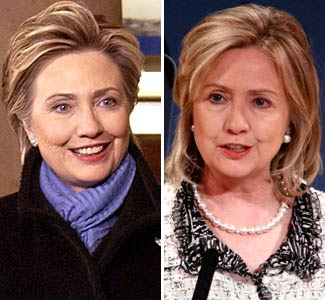
She's going with a Secretary-of-State-worthy 'do these days, but the former first lady has seen plenty of hairstyle changes over the years. She once joked about her ever-changing look.

Sarah Palin
Sarah Palin
The former governor caught Oprah Winfrey off-guard when she ditched her famous hairstyle for an interview.

Keri Russell
Keri Russell
Some blamed the "Felicity" actress's drastic haircut storyline for a change in the show's ratings. The show's network even changed its policy. Russell fans had a common reaction to the new 'do.

Angelina Jolie
Angelina Jolie
Angelina's sporting new bangs for a movie role, and her daughter Shiloh's short new 'do has become tabloid fodder.
Source: msn
World’s Most Powerful Women
Posted by Shazy on Tuesday, March 1, 2011
World’s Most Powerful Women
![]() |
| World’s Most Powerful Women |
![]() |
| Michelle Obama |
The first lady has the ear and the confidence of the commander in chief. She has made headlines with her nationwide anti-obesity program. (Some of the press has been negative.) Also on her agenda: supporting the arts and helping troops.
![]() |
| Hillary Clinton |
Secretary of State Clinton took her oath of office in January 2009. The former first lady and senator now heads up global initiatives, discusses weighty issues at home and tackles grave dilemmas abroad.
![]() |
| Angela Merkel |
Chancellor of Germany Merkel — now serving her second term — holds a historically significant title. In her post, she has her finger on the pulse of this major power.
![]() |
| Oprah Winfrey |
The media mogul has dominated the talk show scene and tapped into print media, radio and even social networking. Winfrey has exercised political clout and has shown a commitment to both philanthropy and education.
![]() |
| Irene Rosenfeld |
Rosenfeld is the CEO of Kraft Foods Inc. and is one of the highest paid women in America. She turned heads last year when she brokered a sweet international deal.
![]() |
| Indra Nooyi |
Indian-born Nooyi is the CEO and chairwoman of PepsiCo. She oversees the company’s main munchies-makers and has launched this sustainability strategy as her growth mission.
![]() |
| Gail Kelly |
Kelly became CEO of Westpac in 2008. The African-born Australian resident went from an unlikely start to a position as a Forbes-ranked powerful force.
![]() |
| Sarah Palin |
Though she and her running mate didn’t make it to the White House, the former Alaska governor has scarcely left the public eye since she hit the campaign trail in 2008. She now makes headlines as a political commentator and conservative tastemaker.
![]() |
| Anne Lauvergeon |
Lauvergeon is the CEO of French conglomerate, Areva, which has an expansive global presence.
![]() |
| Tina Brown |
British-born Brown grew to fame editing revered American magazines in the ‘80s and ‘90s and has set about revamping another newsstand standard. Her new endeavor also includes an online component.
![]() |
| Cristina Fernandez de Kirchner |
Since assuming the role of Argentina’s first elected female president in 2007, Kirchner has faced domestic unrest and scandal, but has also ushered in historic change.
![]() |
| Dilma Rousseff |
Brazil’s first female president has only been in office since January, but in that time, she has already achieved her first legislative victory and has made plans to meet with another famous-first leader.
World’s Most Powerful Women
Posted by Shazy
World’s Most Powerful Women
![]() |
| World’s Most Powerful Women |
![]() |
| Michelle Obama |
The first lady has the ear and the confidence of the commander in chief. She has made headlines with her nationwide anti-obesity program. (Some of the press has been negative.) Also on her agenda: supporting the arts and helping troops.
![]() |
| Hillary Clinton |
Secretary of State Clinton took her oath of office in January 2009. The former first lady and senator now heads up global initiatives, discusses weighty issues at home and tackles grave dilemmas abroad.
![]() |
| Angela Merkel |
Chancellor of Germany Merkel — now serving her second term — holds a historically significant title. In her post, she has her finger on the pulse of this major power.
![]() |
| Oprah Winfrey |
The media mogul has dominated the talk show scene and tapped into print media, radio and even social networking. Winfrey has exercised political clout and has shown a commitment to both philanthropy and education.
![]() |
| Irene Rosenfeld |
Rosenfeld is the CEO of Kraft Foods Inc. and is one of the highest paid women in America. She turned heads last year when she brokered a sweet international deal.
![]() |
| Indra Nooyi |
Indian-born Nooyi is the CEO and chairwoman of PepsiCo. She oversees the company’s main munchies-makers and has launched this sustainability strategy as her growth mission.
![]() |
| Gail Kelly |
Kelly became CEO of Westpac in 2008. The African-born Australian resident went from an unlikely start to a position as a Forbes-ranked powerful force.
![]() |
| Sarah Palin |
Though she and her running mate didn’t make it to the White House, the former Alaska governor has scarcely left the public eye since she hit the campaign trail in 2008. She now makes headlines as a political commentator and conservative tastemaker.
![]() |
| Anne Lauvergeon |
Lauvergeon is the CEO of French conglomerate, Areva, which has an expansive global presence.
![]() |
| Tina Brown |
British-born Brown grew to fame editing revered American magazines in the ‘80s and ‘90s and has set about revamping another newsstand standard. Her new endeavor also includes an online component.
![]() |
| Cristina Fernandez de Kirchner |
Since assuming the role of Argentina’s first elected female president in 2007, Kirchner has faced domestic unrest and scandal, but has also ushered in historic change.
![]() |
| Dilma Rousseff |
Brazil’s first female president has only been in office since January, but in that time, she has already achieved her first legislative victory and has made plans to meet with another famous-first leader.
Babies in Frontier States Have More Unusual Names
Posted by Shazy on Thursday, February 24, 2011
Babies in Frontier States Have More Unusual Names
Babies born in newer U.S. states have more distinctive names compared with their counterparts in older regions such as New England, a new study finds.It turns out, the same values that pushed adventurous individuals into new territories as our country was being populated may still show up in the names their descendants give to babies, a new study finds.
In more recently established states, such as Washington and Oregon, parents tend to choose less common baby names, while parents in "older" areas, such as the original 13 states, go for more popular names.
Frontiers typically have fewer established institutions or infrastructure, and often occupy harsh environments. Early pioneers couldn't rely on others for help in such sparsely populated areas.These factors "select for people who are high in individualism and foster and reward individualistic values such as uniqueness and self-reliance," said lead researcher Michael Varnum of the University of Michigan. "This leads to regional cultures which perpetuate these values, which in turn shape behavioral practices, such as baby naming.
Psychologist Jean Twenge of San Diego State University, who studies baby naming, applauds Varnum's study on frontiers and unique baby names, which is detailed in the February 2011 issue of the journal Psychological Science.
"It's a really fascinating illustration of the impact of regional culture on naming choices," said Twenge, author of "The Narcissism Epidemic: Living in the Age of Entitlement" (Free Press, April 2009).
"Even though other people who came later may not have been so individualistic, that culture was set up," Twenge told LiveScience. "That legacy of the frontier is going to live on, and that shows up in baby names."
What names say about culture
The names we choose for our children do often reflect parents' values. "It's a very heartfelt choice and a noncommercial choice of what's important to us," said Laura Wattenberg, author of the book "The Baby Name Wizard" (Three Rivers Press, 2005) and creator of the website BabyNameWizard.com.
Wattenberg's recent research showed that the meaning conveyed by a baby's name (what it tells others about the parents' tastes and background) has surged over the last 25 years as baby names have become more diverse and numerous.
"I'm convinced they're absolutely right in the core data that there's no question that the American frontier is a naming wonderland," Wattenberg told LiveScience. "Sarah Palin, even though she talks about traditional values, she's a perfect representative of frontier naming." Her kids are named Track, Willow, Trig, Bristol and Piper.
Even so, it's not simple to draw a causal connection between the character of a particular state and the naming conventions there. "Leaping from that to the idea that it represents the spirit of independence, I think there are a lot of other factors you need to consider when drawing that conclusion," Wattenberg said.
Baby names moving west
In the new study, Varnum and his University of Michigan colleague Shinobu Kitayama compared the commonness of popular baby names between relatively recently settled regions of the United States and older areas. The team used 2007 baby-name data collected by the Social Security Administration.
In New England states, more babies were given the most popular boys' and girls' names than they were in frontier states – those in the Mountain West and Pacific Northwest.
Statistical analyses showed the longer ago a state had achieved statehood, the more likely it was to have a higher percentage of people with one of the top 10 most popular baby names. The results held even after the researchers accounted for other factors that might impact baby-name choices, including population density, ethnicity of a state and median income.
The following is the study's ranked list of U.S. states where prevalence of common names is lowest (with No. 1 being the most individualistic), based on percentage of babies who had one of the top 10 most popular names of that year.
Boys' names:
- Hawaii
- Wyoming
- Louisiana
- Idaho
- Oklahoma
- Montana
- Colorado
- Nebraska
- Washington
- Oregon
- Hawaii
- New Mexico
- Mississippi
- Nevada
- Georgia
- Wyoming
- Arizona
- Alaska
- Maryland
- South Carolina
Boys' names
- New Hampshire
- Rhode Island
- Connecticut
- New Jersey
- Massachusetts
- West Virginia
- Maine
- New York
- Tennessee
- Kentucky
- Maine
- Vermont
- New Hampshire
- Rhode Island
- West Virginia
- North Dakota
- Massachusetts
- Connecticut
- Kentucky
- Iowa
However, the link was much stronger for boys' names than for girls', and after the researchers accounted for population density, the effect of eastern or western region on girls' names was negligible.
International study
To see if the same phenomenon held across entire nations, the team looked at baby-name data from 2007 for nine European countries (Austria, Denmark, England, Hungary, Ireland, Norway, Scotland, Spain and Sweden), and four frontier countries (Australia, Canada, New Zealand and the United States).
A similar pattern was found on this front as well, with the newer countries generally sporting more diverse names. In addition, countries that scored higher on an "individualism index" also had fewer babies who were given the most popular names at the time, compared with the countries that scored low on individualism.
But Wattenberg cautioned that the same factors may not be at work since some countries have rules for what parents can name their babies.
For instance, Denmark has a baby-naming rule list translated as the List over Personal Names. If a desired name is not on the list, a family can submit a written application to get consent from the Personal Names Committee under the auspices of the Danish Language Council. Names that aren't considered "personal names," including nicknames and "names, which can be feared to be a burden to the bearer," cannot expect to be approved, the committee states on its website.
Sweden, Hungary, Norway and other countries also have baby-naming laws.
"The idea of attributing a difference to some basic character when in fact, in one case, there are legal limits and in another case there aren't – they are not fundamentally comparable," Wattenberg told LiveScience.
Wattenberg said while she wasn't criticizing the study, she was pointing out that there could be other reasons behind some of the findings, particularly the international ones. For instance, she has found maternal age impacts baby names, where moms from urban, more affluent areas tend to choose more traditional names, which correlates with them waiting until they're older to have children.
More unique baby names now
Twenge said she saw a connection between her own work and the regional and demographic patterns in names found by Varnum.
Rather than looking at the popularity of common names across regions, Twenge studied the trend over time. It turns out, compared with decades ago, parents these days are choosing more unusual names for kids, which could suggest an emphasis on uniqueness and individualism.
Twenge's latest research, detailed in the January 2010 issue of the journal Social Psychological and Personality Science, revealed that about 40 percent of boys received one of the 10 most common names in the 1880s, while now fewer than 10 percent do. For girls, the percentage of those with a name in the top 10 dropped from 25 percent in about 1945 to 8 percent in 2007.
Read More: Yahoo
Babies in Frontier States Have More Unusual Names
Posted by Shazy
Babies in Frontier States Have More Unusual Names
Babies born in newer U.S. states have more distinctive names compared with their counterparts in older regions such as New England, a new study finds.It turns out, the same values that pushed adventurous individuals into new territories as our country was being populated may still show up in the names their descendants give to babies, a new study finds.
In more recently established states, such as Washington and Oregon, parents tend to choose less common baby names, while parents in "older" areas, such as the original 13 states, go for more popular names.
Frontiers typically have fewer established institutions or infrastructure, and often occupy harsh environments. Early pioneers couldn't rely on others for help in such sparsely populated areas.
These factors "select for people who are high in individualism and foster and reward individualistic values such as uniqueness and self-reliance," said lead researcher Michael Varnum of the University of Michigan. "This leads to regional cultures which perpetuate these values, which in turn shape behavioral practices, such as baby naming.
Psychologist Jean Twenge of San Diego State University, who studies baby naming, applauds Varnum's study on frontiers and unique baby names, which is detailed in the February 2011 issue of the journal Psychological Science.
"It's a really fascinating illustration of the impact of regional culture on naming choices," said Twenge, author of "The Narcissism Epidemic: Living in the Age of Entitlement" (Free Press, April 2009).
"Even though other people who came later may not have been so individualistic, that culture was set up," Twenge told LiveScience. "That legacy of the frontier is going to live on, and that shows up in baby names."
What names say about culture
The names we choose for our children do often reflect parents' values. "It's a very heartfelt choice and a noncommercial choice of what's important to us," said Laura Wattenberg, author of the book "The Baby Name Wizard" (Three Rivers Press, 2005) and creator of the website BabyNameWizard.com.
Wattenberg's recent research showed that the meaning conveyed by a baby's name (what it tells others about the parents' tastes and background) has surged over the last 25 years as baby names have become more diverse and numerous.
"I'm convinced they're absolutely right in the core data that there's no question that the American frontier is a naming wonderland," Wattenberg told LiveScience. "Sarah Palin, even though she talks about traditional values, she's a perfect representative of frontier naming." Her kids are named Track, Willow, Trig, Bristol and Piper.
Even so, it's not simple to draw a causal connection between the character of a particular state and the naming conventions there. "Leaping from that to the idea that it represents the spirit of independence, I think there are a lot of other factors you need to consider when drawing that conclusion," Wattenberg said.
Baby names moving west
In the new study, Varnum and his University of Michigan colleague Shinobu Kitayama compared the commonness of popular baby names between relatively recently settled regions of the United States and older areas. The team used 2007 baby-name data collected by the Social Security Administration.
In New England states, more babies were given the most popular boys' and girls' names than they were in frontier states – those in the Mountain West and Pacific Northwest.
Statistical analyses showed the longer ago a state had achieved statehood, the more likely it was to have a higher percentage of people with one of the top 10 most popular baby names. The results held even after the researchers accounted for other factors that might impact baby-name choices, including population density, ethnicity of a state and median income.
The following is the study's ranked list of U.S. states where prevalence of common names is lowest (with No. 1 being the most individualistic), based on percentage of babies who had one of the top 10 most popular names of that year.
Boys' names:
- Hawaii
- Wyoming
- Louisiana
- Idaho
- Oklahoma
- Montana
- Colorado
- Nebraska
- Washington
- Oregon
- Hawaii
- New Mexico
- Mississippi
- Nevada
- Georgia
- Wyoming
- Arizona
- Alaska
- Maryland
- South Carolina
Boys' names
- New Hampshire
- Rhode Island
- Connecticut
- New Jersey
- Massachusetts
- West Virginia
- Maine
- New York
- Tennessee
- Kentucky
- Maine
- Vermont
- New Hampshire
- Rhode Island
- West Virginia
- North Dakota
- Massachusetts
- Connecticut
- Kentucky
- Iowa
However, the link was much stronger for boys' names than for girls', and after the researchers accounted for population density, the effect of eastern or western region on girls' names was negligible.
International study
To see if the same phenomenon held across entire nations, the team looked at baby-name data from 2007 for nine European countries (Austria, Denmark, England, Hungary, Ireland, Norway, Scotland, Spain and Sweden), and four frontier countries (Australia, Canada, New Zealand and the United States).
A similar pattern was found on this front as well, with the newer countries generally sporting more diverse names. In addition, countries that scored higher on an "individualism index" also had fewer babies who were given the most popular names at the time, compared with the countries that scored low on individualism.
But Wattenberg cautioned that the same factors may not be at work since some countries have rules for what parents can name their babies.
For instance, Denmark has a baby-naming rule list translated as the List over Personal Names. If a desired name is not on the list, a family can submit a written application to get consent from the Personal Names Committee under the auspices of the Danish Language Council. Names that aren't considered "personal names," including nicknames and "names, which can be feared to be a burden to the bearer," cannot expect to be approved, the committee states on its website.
Sweden, Hungary, Norway and other countries also have baby-naming laws.
"The idea of attributing a difference to some basic character when in fact, in one case, there are legal limits and in another case there aren't – they are not fundamentally comparable," Wattenberg told LiveScience.
Wattenberg said while she wasn't criticizing the study, she was pointing out that there could be other reasons behind some of the findings, particularly the international ones. For instance, she has found maternal age impacts baby names, where moms from urban, more affluent areas tend to choose more traditional names, which correlates with them waiting until they're older to have children.
More unique baby names now
Twenge said she saw a connection between her own work and the regional and demographic patterns in names found by Varnum.
Rather than looking at the popularity of common names across regions, Twenge studied the trend over time. It turns out, compared with decades ago, parents these days are choosing more unusual names for kids, which could suggest an emphasis on uniqueness and individualism.
Twenge's latest research, detailed in the January 2010 issue of the journal Social Psychological and Personality Science, revealed that about 40 percent of boys received one of the 10 most common names in the 1880s, while now fewer than 10 percent do. For girls, the percentage of those with a name in the top 10 dropped from 25 percent in about 1945 to 8 percent in 2007.
Read More: Yahoo
Glee Casting Call For Sarah Palin Type Character - Tea Party and Glee?
Posted by Shazy on Saturday, February 19, 2011
The Fox TV show Glee has placed a casting call for a "Sarah Palin type character" for a role on the hit show.
Are they ready to now mock the Tea Party?
The character is named Tammy Jean, and described as a "middle-aged recent Tea Party candidate and home schooler — a Sarah Palin type."
However, show creator Ryan Murphy says he is not bringing Tammy Jean / Sarah Palin on the show to mock and make fun of, but to be inclusive.
“We’ve taken a couple jabs at the right wing this year,” Murphy told TV Guide last June.
“So what I want to do with this character is have someone who Christian kids and parents can recognize and say, ‘Oh, look — I’m represented there, too!’ If we’re trying to form a world of inclusiveness, we’ve got to include that point of view as well.”
“Pat me on the back,” Ryan Murphy says, “after two seasons, we’re not going to be bigots anymore!”
Read More: Nationalledger
Labels:
Barack Obama,
character,
democrats,
facebook,
Glee,
GOP,
governor,
Hollywood,
Obama,
Palin,
president,
republican,
republicans,
sarah palin,
the Tea Party,
TV,
twitter
Odd Future's Insane 'Fallon' Performance
Posted by Shazy on Thursday, February 17, 2011
Last night, the L.A. rap crew Odd Future made their television debut on "Late Night with Jimmy Fallon", and pretty much proved in an instant why people can't shut up about them. With the Roots backing them up, Tyler, the Creator and Hodgy Beats delivered an absolutely insane performance of "Sandwitches" (from their MellowHype project's BlackenedWhite album) that we could happily write 2,000 words about-- if we wanted to ruin the surprise. Watch it here:http://pitchfork.com/news/41608-watch-odd-futures-insane-fallon-performance/
More about → Odd Future's Insane 'Fallon' Performance
Labels:
jimmy fallon,
late night,
los angeles,
movies,
music video,
new album,
new york,
new york city,
president,
sarah palin,
the American,
the roots,
twitter
Palin Hires Chief
Posted by Shazy on Wednesday, February 16, 2011
Another bone being thrown to the lame stream media, or something else? Sarah Palin has hired Republican strategist Michael Glassner to serve as Chief Of Staff for her political action committee, Sarah PAC, according to CNN. Problem with Glassner is that he’s a former Bob Dole AND John McCain adviser, which certainly doesn’t impress me.
More about → Palin Hires Chief
Labels:
chief of staff,
CNN,
CPAC,
facebook,
Glassner,
google news,
governor,
hires,
michael,
MSN News,
Obama,
Palin Hires Chief,
president,
sarah palin,
twitter,
yahoo news
CPAC Ron Paul
Posted by Shazy
In a strong reflection of just how strong his standing remains within the die-hard conservative community, Texas Republican and 2008 presidential candidate Rep. Ron Paul won the Conservative Political Action Conference straw poll on Saturday, earning nearly one-third (31 percent) of the entire vote. The crowd, however, booed heavily when the results were announced. Paul was far and away the most widely anticipated speaker at the three-day conference, with his base of "Paulites" streaming into the main auditorium to hear him rail against government overreach and neoconservativism on Friday afternoon. In many respects, his win in the CPAC poll seemed pre-ordained -- his band of followers having a well-earned reputation for flooding polls and forums like these. What it portends for a possible 2012 presidential run is anyone's guess. Paul had a similar cult-like following during the 2008 election, only to garner a relatively small chunk of the actual vote.
The other potential candidates who scored well and are more "mainstream" picks for the Republican nomination include former Massachusetts Gov. Mitt Romney, who earned 22 percent of the vote, and former Alaska Gov. Sarah Palin who came in third with seven percent. Romney had won the last three CPAC polls. Minnesota Governor Tim Pawlenty, another talked about 2012 aspirant, tied "undecided" for fourth place at six percent.
Source: huffingtonpost
More about → CPAC Ron Paul
The other potential candidates who scored well and are more "mainstream" picks for the Republican nomination include former Massachusetts Gov. Mitt Romney, who earned 22 percent of the vote, and former Alaska Gov. Sarah Palin who came in third with seven percent. Romney had won the last three CPAC polls. Minnesota Governor Tim Pawlenty, another talked about 2012 aspirant, tied "undecided" for fourth place at six percent.
Source: huffingtonpost