Anti-Gravity Yoga. In the West a few years boom continues - more and more people begin to engage in a new kind of fitness - antigravity yoga . Fundamentally new kind of yoga devised a gymnast from the United States, Christopher Harrison, who offered to do ... upside down.
Showing posts with label health. Show all posts
Home » Posts filed under health
Anti-Gravity Yoga
Posted by Shazy on Thursday, August 18, 2011
Labels:
Art,
Cool,
health,
Interesting
Common Health Problems
Posted by Shazy on Friday, April 1, 2011
Common Health Problems
Top 10 common health problems
Chronic diseases and conditions are the leading causes of death and disability in the United States, according to the federal agency that tracks public health matters. In 2005, nearly one out every two adults had at least one chronic illness. Read this list of the most common health problems and learn about ways to combat them.
Scroll down to read about:
Asthma
Arthritis
Stroke
Most Common Phobias
Posted by Shazy on Wednesday, March 30, 2011
Most Common Phobias
Most Common Phobias
Most Common Phobias
Arachnophobia
Arachnophobia
They don’t call them creepy crawlies for nothing. This doctor found animal phobias to be among the most frequent fears in children.
Social phobia
Social phobia
The Mayo Clinic saysit's normal to feel nervous in some social situations. But sometimes those fears can be heightened.
Agoraphobia
Agoraphobia
The fact that this word comes from the Greek word for “marketplace” clues you in to the kind of fear it is.
Claustrophobia
Claustrophobia
This word evolved from the Latin word for “cloister,” which means this.
Acrophobia
Acrophobia
Most people who suffer with Acrophobia often experience vertigo.
Astraphobia
Other names for this condition. See images of the feared storms.
Necrophobia
Necrophobia
The horror film genre would not have been the same without this fear lurking in the hearts of millions. Not to be confused with thanatophobia.
Nyctophobia
Nyctophobia
Nyctophobia is common in small children, but if it persists, it could be the sign of a medical condition. Here’s something that may help those who suffer with this condition.
Ophidiophobia
Ophidiophobia
Part of a larger fear, there are a lot of people wary of these creatures.
Source:Specials
Medical Miracles
Posted by Shazy on Tuesday, March 29, 2011
Medical Miracles
Medical Miracles
Medical Miracles
A man who recently received the first full face transplant in the U.S. is the latest case of people who defy the odds by overcoming life-threatening illnesses and injuries. Read about a girl who survived months without a heart, a brain surgery survivor who went on to achieve amazing athletic feats, and other tales of medical miracles.
Scroll down to find out about:
A baby born twice
An internal decapitation
Zheng Cao
Zheng Cao
Mezzo soprano Zheng Cao was given six months to live back in 2009. What was the diagnosis? The San Francisco-based opera singer underwent a successful surgery that eradicated all of the deadly tumors that plagued her. Her medical nightmare had a storybook ending.
Tracy Hermanstorfer
Tracy Hermanstorfer
This Colorado mom died while giving birth on Christmas Eve 2009. When doctors rushed to continue delivering the baby, they found he wasn’t breathing. Shortly after the birth, Hermanstorfer inexplicably returned to life and, with help from medical staff, so did the baby.
Macie Hope McCartney
When her mother was about six months’ pregnant, doctors had to remove 80 percent of baby Macie’s body from the womb to conduct prenatal surgery. She was then returned inside her mother and the healthy baby was born “again” 10 weeks later.
Rae Kupferschmidt
Rae Kupferschmidt
In 2008, doctors declared this 65-year-old woman brain-dead, removed her from life support and sent her home to live out her final days. Shortly after returning home, the comatose mother of two showed signs of recovery, baffling both family and doctors.
D’Zhana Simmons
D’Zhana Simmons
In 2008, this 14-year-old South Carolinian received an artificial heart that functioned in the absence of a real one. Her case stood out because of her age and the sheer length of time during which she had no actual heart.
Shannon Malloy
Shannon Malloy
A 2007 car accident separated Malloy’s skull from her spine.The Nebraska woman was saved with head and neck screws that formed a “stabilizing halo.”
Alcides Moreno
Alcides Moreno
Moreno and his brother were washing apartment building windows in 2007, when both fell. Only 27-year-old Moreno survived. After transfusions and operations, he was able to speak his first words weeks later, on Christmas Day.
Diane Van Deren
Diane Van Deren
In 1997, Van Deren underwent a lobectomy to help cure a serious health problem. The brain surgery left her with major drawbacks, but also enabled her achieve great athletic success.
Source:Specials
Malawi People Eat What Tastes Are Too Heavy
Posted by Shazy on Thursday, March 10, 2011
Malawi People Eat What Tastes Are Too Heavy
The country called Malawi is a landlocked country in southeastern Africa. Malawi is an agricultural country, is the United Nations declared the world's least developed countries.
Wellcome Image Awards 2011
Posted by Shazy on Saturday, February 26, 2011
Wellcome Image Awards 2011
![]() |
| Wellcome Image Awards 2011 |
Striking microscope images nab awards
Colorful shots of a ruby-tailed wasp and a human chromosome bring mostly unseen objects to life.
![]() |
| Wellcome Image Awards 2011 |
Wellcome Images is world's leading source of ...
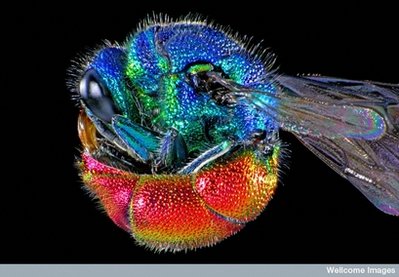
Wellcome Images is the world's leading source of images of medicine and its history. The Wellcome Image Awards recognize the creators of the most informative, striking and technically excellent images among recent acquisitions. You can view all of the 2011 winners at http://www.wellcomeimageawards.org/. This photomicrograph shows an adult ruby-tailed wasp curled into a ball. The wasp was lit with two electronic flashes while imaging to highlight the natural iridescent colours on its body.![]() |
| Wellcome Image Awards 2011 |
Photomicrograph of a mosquito from the Culex ...
Photomicrograph of a mosquito from the Culex genus. This image shows the whole body of an adult male. The sample is from a microscope slide created in the middle of the 20th century.![]() |
| Wellcome Image Awards 2011 |
Cell division and gene expression
Cell division and gene expression in plant cells. Confocal micrograph showing the expression of different fluorescent proteins in the stem of a thale cress seedling (Arabidopsis thaliana). Arabidopsis was the first plant to have its entire genome sequenced and is an important model for studying plant biology. The middle of the image shows a region of high cell proliferation, which drives the growth and branching of the seedling.![]() |
| Wellcome Image Awards 2011 |
Polarised photomicrograph showing rows of suckers
Polarised photomicrograph showing the rows of suckers on the foreleg of a male diving beetle. Commonly known as the great diving beetle, these are largest freshwater beetles in the UK. They have a large streamlined body that is dark brown in colour, with a yellow abdomen and yellow legs. This image was produced by passing light through coloured filters, a technique known as Rheinberg illumination.![]() |
| Wellcome Image Awards 2011 |
Cavefish embryo at around five days post-fertilisation. ...
Cavefish embryo at around five days post-fertilisation. The embryo has been stained with an antibody against a calcium-binding protein (in green) to show different neuronal types and their processes in the nervous system. This staining also reveals taste buds, which are located around the mouth and along the body of the cavefish.![]() |
| Wellcome Image Awards 2011 |
Honey Bee - False colour scanning electron micrograph ...
Honey Bee - False colour scanning electron micrograph of a Honey bee. The honeybee has a hairy thorax and segented abdomen, a pair of double wings and three pairs of segmented legs, each one with a different 'tool', designed for a specific functions to assist in the collection and transport of pollen.![]() |
| Wellcome Image Awards 2011 |
Image of human chromosome in metaphase
Image of a human chromosome in metaphase. The colours in this image indicate the density of chromatin in the chromosome, like a heat map (red shows high density, blue low). A low density of chromatin indicates a high level of gene expression, and a high density indicates repression of gene expression.![]() |
| Wellcome Image Awards 2011 |
Moth wing scales
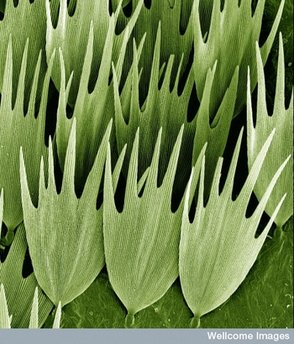
Moth wing scales. Scanning electron micrograph (SEM) of the scales on the wing of a Madagascan moon moth, Argema mittrei. This moth is also known as the Comet moth, after its very long tail. The tail span is 15 cm and wing span 20 cm, making it one of the world's largest silk moths.![]() |
| Wellcome Image Awards 2011 |
This colour-enhanced photomicrograph shows different ...
This colour-enhanced photomicrograph shows different species of bacteria that cause dental plaque - a colourless film that forms on teeth caused by the growth of bacterial colonies. The sample was removed from the mouth of a patient diagnosed with an aggressive form of gum disease.Wellcome Image Awards 2011
Posted by Shazy
Wellcome Image Awards 2011
![]() |
| Wellcome Image Awards 2011 |
Striking microscope images nab awards
Colorful shots of a ruby-tailed wasp and a human chromosome bring mostly unseen objects to life.
![]() |
| Wellcome Image Awards 2011 |
Wellcome Images is world's leading source of ...
Wellcome Images is the world's leading source of images of medicine and its history. The Wellcome Image Awards recognize the creators of the most informative, striking and technically excellent images among recent acquisitions. You can view all of the 2011 winners at http://www.wellcomeimageawards.org/. This photomicrograph shows an adult ruby-tailed wasp curled into a ball. The wasp was lit with two electronic flashes while imaging to highlight the natural iridescent colours on its body.![]() |
| Wellcome Image Awards 2011 |
Photomicrograph of a mosquito from the Culex ...
Photomicrograph of a mosquito from the Culex genus. This image shows the whole body of an adult male. The sample is from a microscope slide created in the middle of the 20th century.![]() |
| Wellcome Image Awards 2011 |
Cell division and gene expression
Cell division and gene expression in plant cells. Confocal micrograph showing the expression of different fluorescent proteins in the stem of a thale cress seedling (Arabidopsis thaliana). Arabidopsis was the first plant to have its entire genome sequenced and is an important model for studying plant biology. The middle of the image shows a region of high cell proliferation, which drives the growth and branching of the seedling.![]() |
| Wellcome Image Awards 2011 |
Polarised photomicrograph showing rows of suckers
Polarised photomicrograph showing the rows of suckers on the foreleg of a male diving beetle. Commonly known as the great diving beetle, these are largest freshwater beetles in the UK. They have a large streamlined body that is dark brown in colour, with a yellow abdomen and yellow legs. This image was produced by passing light through coloured filters, a technique known as Rheinberg illumination.![]() |
| Wellcome Image Awards 2011 |
Cavefish embryo at around five days post-fertilisation. ...
Cavefish embryo at around five days post-fertilisation. The embryo has been stained with an antibody against a calcium-binding protein (in green) to show different neuronal types and their processes in the nervous system. This staining also reveals taste buds, which are located around the mouth and along the body of the cavefish.![]() |
| Wellcome Image Awards 2011 |
Honey Bee - False colour scanning electron micrograph ...
Honey Bee - False colour scanning electron micrograph of a Honey bee. The honeybee has a hairy thorax and segented abdomen, a pair of double wings and three pairs of segmented legs, each one with a different 'tool', designed for a specific functions to assist in the collection and transport of pollen.![]() |
| Wellcome Image Awards 2011 |
Image of human chromosome in metaphase
Image of a human chromosome in metaphase. The colours in this image indicate the density of chromatin in the chromosome, like a heat map (red shows high density, blue low). A low density of chromatin indicates a high level of gene expression, and a high density indicates repression of gene expression.![]() |
| Wellcome Image Awards 2011 |
Moth wing scales
Moth wing scales. Scanning electron micrograph (SEM) of the scales on the wing of a Madagascan moon moth, Argema mittrei. This moth is also known as the Comet moth, after its very long tail. The tail span is 15 cm and wing span 20 cm, making it one of the world's largest silk moths.![]() |
| Wellcome Image Awards 2011 |
This colour-enhanced photomicrograph shows different ...
This colour-enhanced photomicrograph shows different species of bacteria that cause dental plaque - a colourless film that forms on teeth caused by the growth of bacterial colonies. The sample was removed from the mouth of a patient diagnosed with an aggressive form of gum disease.8 Germiest Public Places
Posted by Shazy on Thursday, February 17, 2011
An average adult can touch as many as 30 objects within a minute, including germ-harboring, high-traffic surfaces such as light switches, doorknobs, phone receivers, and remote controls. At home, you do all that you can to keep the germs at bay. But what happens when you step out the door to go to dinner, do some grocery shopping, or visit the doctor's office? Know where germs are most likely to lurk, as you'll find out here.
Restaurant menus
Have you ever seen anyone wash off a menu? Probably not. A recent study in the Journal of Medical Virology reported that cold and flu viruses can survive for 18 hours on hard surfaces. If it's a popular restaurant, hundreds of people could be handling the menus--and passing their germs on to you. Never let a menu touch your plate or silverware, and wash your hands after you place your order.
Lemon wedges
According to a 2007 study in the Journal of Environmental Health, nearly 70% of the lemon wedges perched on the rims of restaurant glasses contain disease-causing microbes. When the researchers ordered drinks at 21 different restaurants, they found 25 different microorganisms lingering on the 76 lemons that they secured, including E. coli and other fecal bacteria. Tell your server that you'd prefer your beverage sans fruit. Why risk it?
Condiment dispensers
It's the rare eatery that regularly bleaches its condiment containers. And the reality is that many people don't wash their hands before eating, says Kelly Reynolds, PhD. So while you may be diligent, the guy who poured the ketchup before you may not have been, which means his germs are now on your fries. Squirt hand sanitizer on the outside of the condiment bottle or use a disinfectant wipe before you grab it. Holding the bottle with a napkin won't help; napkins are porous, so microorganisms can pass right through, Reynolds says.
Restroom door handles
Don't think you can escape the restroom without touching the door handle? Palm a spare paper towel after you wash up and use it to grasp the handle. Yes, other patrons may think you're a germ-phobe--but you'll never see them again, and you're the one who won't get sick.
Soap dispensers
About 25% of public restroom dispensers are contaminated with fecal bacteria. Soap that harbors bacteria may seem ironic, but that's exactly what a recent study found. "Most of these containers are never cleaned, so bacteria grow as the soap scum builds up," says Charles Gerba, PhD. "And the bottoms are touched by dirty hands, so there's a continuous culture feeding millions of bacteria." Be sure to scrub hands thoroughly with plenty of hot water for 15 to 20 seconds--and if you happen to have an alcohol-based hand sanitizer, use that, too.
Grocery carts
The handles of almost two-thirds of the shopping carts tested in a 2007 study at the University of Arizona were contaminated with fecal bacteria. In fact, the bacterial counts of the carts exceeded those of the average public restroom. Swab the handle with a disinfectant wipe before grabbing hold (stores are starting to provide them, so look around for a dispenser). And while you're wheeling around the supermarket, skip the free food samples, which are nothing more than communal hand-to-germ-to-mouth zones.
Airplane bathrooms
When Gerba tested for microbes in the bathrooms of commercial jets, he found surfaces from faucets to doorknobs to be contaminated with E. coli. It's not surprising, then, that you're 100 times more likely to catch a cold when you're airborne, according to a recent study in the Journal of Environmental Health Research. To protect yourself, try taking green tea supplements. In a 2007 study from the University of Florida, people who took a 450-milligram green tea supplement twice a day for 3 months had one-third fewer days of cold symptoms. The supplement brand used in the study was Immune Guard ($30 for 60 pills; immune-guard.us).
Doctor's office
A doctor's office is not the place to be if you're trying to avoid germs. These tips can help limit your exposure.
1. Take your own books and magazines (and kid's toys, if you have your children or grandchildren with you).
2. Also pack your own tissues and hand sanitizers, which should be at least 60% alcohol content.
3. In the waiting room, leave at least two chairs between you and the other patients to reduce your chances of picking up their bugs. Germ droplets from coughing and sneezing can travel about 3 feet before falling to the floor.
Read More: MSN
Labels:
adult,
bacteria,
doorknobs,
E. coli,
germ,
germs,
hand sanitizer,
hands,
health,
kitchen sink,
Public Places,
public restrooms,
purse,
surfaces,
the germs,
wash your hands,
wipes