Showing posts with label researchers. Show all posts

The First Baby With Three Biological Parents

Posted by Shazy on Saturday, March 12, 2011


The First Baby With Three Biological Parents
The first baby with three biological parents could be conceived next year after the Government announced a major review of Britain’s fertility laws.

The move would allow doctors to use a revolutionary IVF technique that prevents incurable, deadly genetic illnesses being passed down from mothers to their children.

Babies created with the therapy – called three-parent IVF – would inherit 98 per cent of their DNA from their ‘real’ parents. The rest would come from a female donor.
More aboutThe First Baby With Three Biological Parents

Face of Incredibly Preserved 700 Years Old Mummy

Posted by Shazy on Friday, March 4, 2011

Face of Incredibly Preserved 700 Years Old Mummy
Eyebrows still intact highlighting amazing level of preservation
Mummy believed to be a high-ranking member of the Ming Dynasty
Wearing silk and cotton, she's the first major discovery in years in the area

These incredible pictures show a 700-year-old mummy, which was discovered by chance - by road workers - in excellent condition in eastern China.
The corpse of the high-ranking woman believed to be from the Ming Dynasty - the ruling power in China between 1368 and 1644 - was stumbled across by a team who were looking to expand a street.
And the mummy, which was found in the city of Taizhou, in the Jiangsu Province, along with two other wooden tombs, offers a fascinating insight into life as it was back then.
Discovered two metres below the road surface, the woman's features - from her head to her shoes - have retained their original condition, and have hardly deteriorated.

When the discovery was made by the road workers, late last month, Chinese archaeologists, from the nearby Museum of Taizhou, were called into excavate the area, the state agency Xinhua News reported.
They were surprised by the remarkably good condition of the woman's skin, hair, eyelashes and face. It was as though she had only recently died.
Face of Incredibly Preserved 700 Years Old Mummy
Her body, which measures 1.5 metres high, was found at the construction site immersed in a brown liquid inside the coffin.
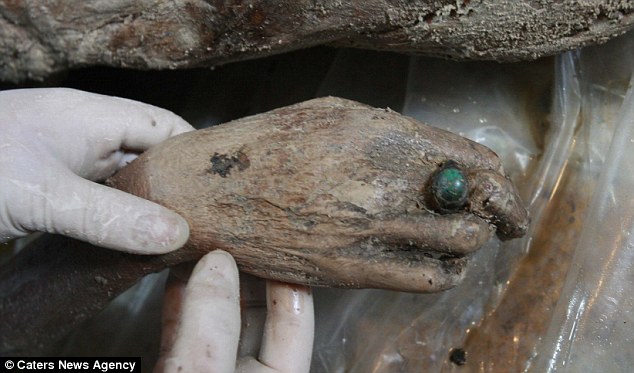
And the coffin was opened earlier this week, on March 1, much to the excitement of the local city - and further afield. And the right hand of the 700-year-old mummy showed her preserved skin, and a ring.
The mummy was wearing traditional Ming dynasty costume, and also in the coffin were bones, ceramics, ancient writings and other relics.
This is the latest discovery after a lull of three years in the area. Indeed, between 1979 and 2008 five mummies were found, all in very good condition.
Those findings raising the interest in learning the techniques of preservation funeral of this dynasty and customs in time to bury the dead.
Director of the Museum of Taizhou, Wang Weiyin, told Xinhua that the mummy's clothes are made mostly of silk, with a little cotton.
He said usually silk and cotton are very hard to preserve and excavations found that this mummifying technology was used only at very high-profile funerals.
The first finding of the Ming Dynasty in Taizhou dates from May 1979 and led the opening of the museum.
At that time the bodies were also found intact, but due to lack of experience of archaeologists only clothing, belts and clamps could be preserved.
The Ming Dynasty, who built the Forbidden City and restored the Great Wall, was the last in China and marked an era of economic growth and cultural splendour which produced the first commercial contacts with the West.
Face of Incredibly Preserved 700 Years Old Mummy

Face of Incredibly Preserved 700 Years Old Mummy

Face of Incredibly Preserved 700 Years Old Mummy

Face of Incredibly Preserved 700 Years Old Mummy

Face of Incredibly Preserved 700 Years Old Mummy

Face of Incredibly Preserved 700 Years Old Mummy

More aboutFace of Incredibly Preserved 700 Years Old Mummy

After 5,300 years, Oetzi the iceman finally shows his face

Posted by Shazy on Tuesday, March 1, 2011

After 5,300 years, Oetzi the iceman finally shows his face
He doesn't look half bad for a 5,300-year-old.

Since his discovery in 1991, Oetzi the iceman's true identity has been shrouded in myth and mystery. Just a faceless corpse that has embodied a bygone era of humankind.

But experts have finally worked out what the world's most famous natural mummy actually looked like.

Using 3D images of the corpse and forensic technology, two Dutch artists - Alfons and Adrie Kennis - painstakingly created a new Oetzi model.

But the one thing they couldn't determine was his natural eye colour. So they went with brown.

The model is on show at the South Tyrol Museum of Archaeology in Bolzano, Italy, alongside his mummified remains.
He was unearthed in September 1991 in the Eastern Alps near the Austro-Italian border by a couple of German tourists trekking through the Oetz Valley, after which he was named.

He was about 46 years old when he met his violent death.

Examinations revealed that he had been wounded by an arrow and possibly finished off with a mace blow to the face.

It is thought the arrow tore a hole in an artery beneath his left collarbone, leading to massive loss of blood - and the shock caused Oetzi to suffer a heart attack.

The fact that the arrow's shaft was pulled out before his death may have worsened the injury.


/div>
The iceman has been crucial to our understanding of how prehistoric people lived, what they wore and even what they ate.

Researchers had previously suggested he was killed by a rival hunter after putting up a fight, and by examining the contents of his stomach, worked out that his final meal consisted of venison and ibex meat.

Archaeologists believe Oetzi, who was carrying a bow, a quiver of arrows and a copper axe, may have been a hunter or warrior killed in a skirmish with a rival tribe.

Researchers say he was about 159cm tall (5ft 2.5in), 46 years old, arthritic and infested with whipworm, an intestinal parasite.

But he may not object to being immortalised in art, as he was apparently a fan himself with several carbon tattoos including groups of short, parallel, vertical lines behind his knees and around both ankles.
More aboutAfter 5,300 years, Oetzi the iceman finally shows his face

The 6,000 Year Old Winery Discovered in Armenia

Posted by Shazy on Tuesday, February 15, 2011

 The wine press (center, with vat slightly to the right), dating to roughly 4100 B.C., was found in the cave among tombs and jars containing dried fruit. This photograph was made when the excavation was in progress.
While digging in a remote cave complex near Armenia's southern border with Iran, in the little village of Areni – known for its winemaking even today – a team of scientists recently happened upon an amazing discovery. Inspired by the possibilities the examination of dried up grape seeds found at the site threw up, the intrepid researchers began to excavate the area further and found the oldest complete wine production facility known to man! This included grape seeds, vats, remains of pressed grapes, a wine press, wine soaked potsherds, cups and drinking bowls, all 6,100 years old!
The team had uncovered the oldest known leather shoe only seven months earlier, but this was something different. The find could have profound implications on our knowledge of domesticated grapes and winemaking – a heady find for the archaeologists involved!
 Visiting the excavations of the Areni-1 cave complex in Armenia, archaeologist Levon Petrosyan contemplates the 6,100-year-old wine-making equipment discovered by an international project co-directed by Boris Gasparyan, Gregory Areshian and Ron Pinhasi
“For the first time, we have a complete archaeological picture of wine production dating back 6,100 years,” said Gregory Areshian, co-director of the excavation and assistant director of UCLA’s Cotsen Institute of Archaeology. Not only does this mean that they had the technology and knowledge to produce wine on a large scale back then, but that the domestication of grapes and winemaking must have been known even earlier to get to the point of formal production.
 The winemaking components were dated with radiocarbon analysis to 4100-4000 B.C., also known as the Copper Age. One shallow basin measured 3 by 3-and-a-half feet, had a thick rim to contain juices and was placed so its users could drain it into the deep vat. The archaeologists believe that this was used as a wine press, and since no implements or pieces were found that would be used to press the grapes, it is believed that they did so the way it is still done in some areas, by trampling on them with bare feet. “People obviously were stomping the grapes with their feet, just the way it was done all over the Mediterranean and the way it was originally done in California,” Areshian said.
 The wine press (center) is more evident in this later photograph of the excavation, behind which an archaeological identification kit is placed. The vat (right of the press), apparently used for accumulating grape juice and the consequent wine fermentation, emerges clearly here as a result of the excavation.
There was evidence of grapes all around and on top of the wine press, handfuls of grape seeds, the remains of pressed grapes, and dozens of dried up vines. These were examined by three different laboratories, and amazingly the species of grape is Vitis vinifera vinifera, the domesticated variety still used today!
 A range of 6,100-year-old desiccated grape stems and dried pressed grapes was found on and around the wine press in the Armenian cave. The chemical studies were led by UCLA scientists and supported by the National Geographic Society, which also funded the archaeological work.
The grapes may have been the same, but we don't see winemaking facilities today where these were found. The winemaking press and vats were among a burial ground in the cave, and the archaeologists believe that it is likely that this particular wine was used for ceremonial purposes. As Asherian said: "This wine wasn’t used to unwind at the end of the day.”
The use of wine in funeral rituals is well-known to have been a part of a number of cultures, including Ancient Egypt. Vats or jugs of wine have been found in the tombs of the dead for use in their journey to the afterlife, and obviously this find in Armenia shows that they not only used wine to ceremonialize their dead but that they also did so to such an extent that they placed the winemaking facilities within the burial grounds itself. There were also numerous clay bowls and even a bone cup among the finds.
 A flashlight illuminates the inside of the vat into which the wine press drained. On the inner surface of the vat below its rim, UCLA chemists found evidence of the plant pigment malvidin, the substance that makes wine stains so difficult to remove from fabric today. The bottom of the vat also is covered with dark gray organic residues.
One of the great things about this discovery is that it confirms the artifacts were used for winemaking in three different ways. Radiocarbon dating and the paleobotanical tests used to detect tartaric acid – which is not just present in grapes but other fruits and vegetables as well – were the previous methods used, but this time the researchers were also able to analyze the residue for the presence of malvidin. Malvidin is a molecule in red wine grapes that gives it the deep dark color and also makes stains hard to remove. There is only one other fruit known to contain it – unlike tartaric acid – and that is pomegranates. Clearly since grapes were found and there were no signs of pomegranates, this had to do with winemaking.
With the incredible success that this team from UCLA has had, funded by the National Geographic Society, one wonders what they might find next in the small cave. When one looks at the photographs of the ancient pottery and realizes that 6000-plus years ago, men and perhaps women were using them, drinking the fruits of their labor, working with them, it seems almost otherworldly.
What man stomped the grapes so his ancestors would be celebrated with wine? Did he have the same worries that we do today about making a life for his family? Or was he a slave, unable to have a family? Were the cups touched by a young woman who had lost a husband to a hunting accident? Every piece of cracked clay pot has been handled by people in an ancient era just as we handle our kitchen pots or workplace materials. They were at the forefront of our modern vineyards and vintages. We know the press itself is one very like those still used in the 19th century. Hopefully the UCLA team will find more answers to the questions about our past and how some of the things we take for granted came to be.
More aboutThe 6,000 Year Old Winery Discovered in Armenia