Showing posts with label science. Show all posts

The incredible 4,500-mile Atlantic Ocean journey of tiny turtles

Posted by Shazy on Thursday, March 10, 2011


The incredible 4,500-mile Atlantic Ocean journey of tiny turtles
Scientists have lifted the lid on an incredible 70-day journey that wild turtles, some younger than six months old, take for the first time.

Researchers tagged some of the smallest and youngest ever baby turtles to be tracked, revealing the epic 4,500 mile journey in the Atlantic Ocean.

The young Loggerhead turtles were monitored by satellite as they made their journey - the equivalent of travelling from London to Mumbai.


Scientists customised the 9gm tracker tags normally used for birds, making them waterproof, before gluing them onto the reptiles' shells.

Jeanette Wyneken and Kate Mansfield, from Florida Atlantic University, said they were amazed at the length of the journey made by the 17 tiny turtles.

'This is the first time turtles aged four months have ever been tagged and tracked by satellite,' said Dr Wyneken.

'Previously we have never known what these young turtles do once they leave their beach nests and swim off into the ocean.

'It was important to us that the tags did not stop them from behaving normally. Thankfully they acted as as if there was nothing attached to there backs at all.

'Seaweed is an important habitat for the turtles and they had no problem moving around it.'

Using data transmitted by the tags, the team was able to map every movement.

Dr Wyneken said: 'The turtles varied a lot in their movements, more so than we expected. They're likely doing much more than just paddling straight to the deep water and riding the current.

'We're very happy and excited by the results.'

The 17 satellite tags cost £32,000 and allowed the animals to be monitored from anywhere on the planet.
The little loggerhead turtles were captured from their Florida beach nests especially to take part the tagging project.

The hand-sized reptiles were between four and six months old when they were released 10-miles east of Palm Beach and weighed only 300 grams.

When they are between six and eight months of age they outgrow the tags which fall off into the sea.

'We're trying to protect them from harm,' said Jeanette.

'The question is one of basic natural history: where are they going? For how long and what are the risks in between?

'If you don't know where they are or what places they're visiting you don't know what areas you need to protect.

'And if you don't have this information you're gambling with the method you're using to protect them and enhance their survival.'

Funding for the project came from the University of New Hampshire's Large Pelagics Research Center, Save Our Seas Foundation, Disney Worldwide Conservation Fund, and the Florida Sea Turtle Licence Plate Grants Program.

The full results of the tracking are expected to be published later this year.


Source: Dailymail
More aboutThe incredible 4,500-mile Atlantic Ocean journey of tiny turtles

After 5,300 years, Oetzi the iceman finally shows his face

Posted by Shazy on Tuesday, March 1, 2011

After 5,300 years, Oetzi the iceman finally shows his face
He doesn't look half bad for a 5,300-year-old.

Since his discovery in 1991, Oetzi the iceman's true identity has been shrouded in myth and mystery. Just a faceless corpse that has embodied a bygone era of humankind.

But experts have finally worked out what the world's most famous natural mummy actually looked like.

Using 3D images of the corpse and forensic technology, two Dutch artists - Alfons and Adrie Kennis - painstakingly created a new Oetzi model.

But the one thing they couldn't determine was his natural eye colour. So they went with brown.

The model is on show at the South Tyrol Museum of Archaeology in Bolzano, Italy, alongside his mummified remains.
He was unearthed in September 1991 in the Eastern Alps near the Austro-Italian border by a couple of German tourists trekking through the Oetz Valley, after which he was named.

He was about 46 years old when he met his violent death.

Examinations revealed that he had been wounded by an arrow and possibly finished off with a mace blow to the face.

It is thought the arrow tore a hole in an artery beneath his left collarbone, leading to massive loss of blood - and the shock caused Oetzi to suffer a heart attack.

The fact that the arrow's shaft was pulled out before his death may have worsened the injury.


/div>
The iceman has been crucial to our understanding of how prehistoric people lived, what they wore and even what they ate.

Researchers had previously suggested he was killed by a rival hunter after putting up a fight, and by examining the contents of his stomach, worked out that his final meal consisted of venison and ibex meat.

Archaeologists believe Oetzi, who was carrying a bow, a quiver of arrows and a copper axe, may have been a hunter or warrior killed in a skirmish with a rival tribe.

Researchers say he was about 159cm tall (5ft 2.5in), 46 years old, arthritic and infested with whipworm, an intestinal parasite.

But he may not object to being immortalised in art, as he was apparently a fan himself with several carbon tattoos including groups of short, parallel, vertical lines behind his knees and around both ankles.
More aboutAfter 5,300 years, Oetzi the iceman finally shows his face

A Geek of Every Color

Posted by Shazy on Saturday, February 26, 2011

A Geek of Every Color
For Black History Month, we look at the inner life of the black geek
There was a time when being a geek -- or a nerd, for that matter -- was just about the worst thing you could be. But with the emergence of a geek culture unashamed to wave its freak flag high, we now find ourselves living in a geek-friendly society. There is no longer shame in being an adult who reads comic books, watches animation, plays video games or enjoys any of the other things that often are attributed to geeks, nerds and other various socially challenged misfits.
Despite an increasingly visible audience that drives much of contemporary pop culture, being a geek or a nerd is still traditionally thought of as a domain exclusive to white people (and select Asian cultures). There is, however, an entire culture of black geeks that has struggled to make itself more visible in the larger world of geekdom. And while the term black geek may conjure up images of Jaleel White as Urkel on "Family Matters" or Alfonso Ribeiro on "Fresh Prince of Bel-Air," the contemporary black geek is actually more like rapper Mos Def or actor Donald Glover on "Community."
The 21st-century black geek is an offshoot of the middle-class buppie and the old-school b-boy culture, both of which were immersed in a deep-rooted Afrocentric understanding of the world at large. Black geeks grew up reading books like "The Autobiography of Malcolm X" and listening to Parliament-Funkadelic, while watching reruns of "The Partridge Family" and flipping through the pages of Spider-Man comic books. Black pop culture historians like Fab 5 Freddy, the original host of "Yo! MTV Raps," and writer Nelson George represent this crossroads of diverse cultural experiences that define the black geek.
Though I cannot speak for all black geeks, as one myself, I have lived a life of athletic ineptitude and literary appreciation that has made me seem like an oddball. There seems to be a sad stereotype that says black people must all excel in sports, while never cracking open a book. But I'm here to say that some of us love to read and couldn't make a free throw if our lives depended on it. And with that in mind, here's a glimpse at some of what defines black geekiness, and how we make due in a world that seldom caters to us specifically.

Icons of Black Geekiness
Just like every culture or ethnicity, black geeks have people who best represent us in the real world. When President Obama admitted that he read comic books, especially Spider-Man, he was propelled to the forefront of black geekiness. Though he still has his place there, Obama will never usurp the throne of Dr. Cornel West, who is king of the black geeks. Not to be outdone by Cornel West, Bill Cosby has contributed greatly to the cause of black geeks, not only with his hit sitcoms, but also with the animated show "Fat Albert and the Cosby Kids." And of course, there are OBGs: original black geeks. People like James Baldwin, Dick Gregory, Malcolm X, Angela Davis and writer, philosopher and activist W.E.B. DuBois, all of whom, as original black geeks, paved the way for Cornel West, Michael Eric Dyson, Nelson George and all the other thinkers who make thinking cool.
'Star Trek'
'Star Trek'
Black geeks love "Star Trek," but don't come at us talking about how cool Benjamin Sisko (Avery Brooks) from "Deep Space Nine" is, or how he was the best captain of all the "Star Trek" franchises. We know this. We also love Lt. Uhura (Nichelle Nichols) and the black Klingons (although we're indifferent to black Vulcans). But the one character from "Star Trek" every black geek loves is Mr. Spock (Leonard Nimoy). He is a vital part of the crew, but every now and then, someone reminds Spock that he's not like them -- usually it's Dr. McCoy calling him a "blasted pointy-eared hobgoblin." Any black geek who has been the only black person in a comic book store, or the only black person in a D&D tournament, or the only black person standing in line waiting to buy the latest "Harry Potter" book, has felt the sting of alienation that plagued Spock every moment he was on the Enterprise. And that is why we love him. Deep down inside, every black geek sees a bit of himself or herself in Mr. Spock.
Marvel Comics
Marvel Comics
In the debate of Marvel vs. DC, most black geeks seem to prefer Marvel and its stable of flawed, angst-ridden characters that spend as much time fighting crime as they do struggling to fit into a society that doesn't always understand them. Keep in mind that our favorite characters are not the token black superheroes like Luke Cage, Falcon or the late and not-so-great Black Goliath. Sure, we have a soft place in our hearts for them, like we do that one cousin who still wears a shower cap everywhere he goes, but these aren't the heroes we black geeks love the most. Captain America's sidekick Falcon was more like a glorified man-servant who could fly, and Luke Cage had terrible fashion sense, and neither of them had a humanity to relate to -- at least not like the humanity of Thor. Sure, he's a Norse god with blond hair and blue eyes, but he's also got a strained relationship with a father he can never seem to please. Black geeks also relate to another blue-eyed hero, the ever-lovin' Thing. Covered in orange rocks, the Thing is a misfit among misfits -- even when he saves the day, some people aren't comfortable with him being around. And finally, there's Spider-Man. Here you have a poor kid, who lives with an old woman who's raising him, and he can't catch a break no matter how hard he tries, which is easier for a black geek to relate to than a muscle-bound soul brotha with bulletproof skin with a tendency to proclaim, "Sweet Christmas!" during a fight.
Hip-Hop Geeks
Hip-Hop Geeks
There was a time when rappers used to brag about how smart they were. Everyone knew that Kool Moe Dee had been to college, not to mention Young MC. Chuck D met the rest of Public Enemy when they were all in college, and then he went on to rap, "From the slammer/swing the hammer like the Mighty Thor," admitting to the world that he was a comic book geek. And then there was Educated Rapper from the group UTFO, Wise Intelligent of Poor Righteous Teachers, and KRS-One (Knowledge Reigns Supreme Over Nearly Everyone) of Boogie Down Productions, all of whom boasted of their intellectual capabilities. But somewhere along the way, hip-hop forgot about "droppin' science" and "schoolin' suckas," and traded college credits for street credentials. Still, there are quite a few rappers out there who are undeniable geeks. Mos Def, Talib Kweli, Common, J-Live, the Roots, De La Soul and Lifesavas all represent the black geek quotient that can still be found in hip-hop, despite a continued attempt to dumb it down.
Science Fiction and Other Flights of Fancy
Black geeks like to read science-fiction, fantasy and horror books just like other geeks. Unfortunately, some of the more popular genre books tend to exclude or marginalize black characters. But that doesn't mean there aren't writers and books out there that speak to black geek culture. Samuel R. Delany (the "Return to Nevèrÿon" series) and the late great Octavia Butler (the "Patternist" series) remain the foremost writers of black geek literature. Both authors wrote numerous novels in multiple genres, and paved the way in literature for Afrofuturism, which has its roots in the spacey music of Sun Ra and Parliament-Funkadelic. Other notable contributors to black geek lit include Tananarive Due, Steve Barnes, John Ridley, L.A. Banks and Walter Mosley.
'Star Wars'
'Star Wars'
Out of fear of being ostracized by the larger geek community, most black geeks will not admit to hating "Star Wars," but we do. It all started with "Episode IV," when it dawned on every black kid watching it that there were no black people anywhere in a galaxy far, far away. We got Lando Calrissian (Billy Dee Williams) in "Empire Strikes Back," but that will never make up for the jaw-dropping monstrosity of Jar Jar Binks. What was George Lucas thinking? The only thing Jar-Jar didn't do was walk around with a bucket of fried chicken. And I'm sorry, but Mace Windu wasn't cutting it either. No, the reality is that while some black geeks will openly lie about how they feel about "Star Wars," deep down inside we all prefer to watch the original "Battlestar Galactica," because that had two black guys on it, and they didn't act like buffoons.
The Black Geek Hall of Fame
If you are a black geek, it doesn't matter what you do -- read comics, play video games, watch movies, roll a 10-sided die in your parents' basement while casting spells -- we're all looking for that one character we can relate to, who speaks to us as black people. Sure, there have been cool characters in a variety of media, but only two have risen above all the others to earn a special place in the Black Geek Hall of Fame. First, we have the animated character Verb from "Schoolhouse Rock." And then we have Winston Zeddemore of "Ghostbusters," played by actor Ernie Hudson. Need I say more?
Read More: MSN
More aboutA Geek of Every Color

A Geek of Every Color

Posted by Shazy

A Geek of Every Color
For Black History Month, we look at the inner life of the black geek
There was a time when being a geek -- or a nerd, for that matter -- was just about the worst thing you could be. But with the emergence of a geek culture unashamed to wave its freak flag high, we now find ourselves living in a geek-friendly society. There is no longer shame in being an adult who reads comic books, watches animation, plays video games or enjoys any of the other things that often are attributed to geeks, nerds and other various socially challenged misfits.
Despite an increasingly visible audience that drives much of contemporary pop culture, being a geek or a nerd is still traditionally thought of as a domain exclusive to white people (and select Asian cultures). There is, however, an entire culture of black geeks that has struggled to make itself more visible in the larger world of geekdom. And while the term black geek may conjure up images of Jaleel White as Urkel on "Family Matters" or Alfonso Ribeiro on "Fresh Prince of Bel-Air," the contemporary black geek is actually more like rapper Mos Def or actor Donald Glover on "Community."
The 21st-century black geek is an offshoot of the middle-class buppie and the old-school b-boy culture, both of which were immersed in a deep-rooted Afrocentric understanding of the world at large. Black geeks grew up reading books like "The Autobiography of Malcolm X" and listening to Parliament-Funkadelic, while watching reruns of "The Partridge Family" and flipping through the pages of Spider-Man comic books. Black pop culture historians like Fab 5 Freddy, the original host of "Yo! MTV Raps," and writer Nelson George represent this crossroads of diverse cultural experiences that define the black geek.
Though I cannot speak for all black geeks, as one myself, I have lived a life of athletic ineptitude and literary appreciation that has made me seem like an oddball. There seems to be a sad stereotype that says black people must all excel in sports, while never cracking open a book. But I'm here to say that some of us love to read and couldn't make a free throw if our lives depended on it. And with that in mind, here's a glimpse at some of what defines black geekiness, and how we make due in a world that seldom caters to us specifically.

Icons of Black Geekiness

Icons of Black Geekiness
Just like every culture or ethnicity, black geeks have people who best represent us in the real world. When President Obama admitted that he read comic books, especially Spider-Man, he was propelled to the forefront of black geekiness. Though he still has his place there, Obama will never usurp the throne of Dr. Cornel West, who is king of the black geeks. Not to be outdone by Cornel West, Bill Cosby has contributed greatly to the cause of black geeks, not only with his hit sitcoms, but also with the animated show "Fat Albert and the Cosby Kids." And of course, there are OBGs: original black geeks. People like James Baldwin, Dick Gregory, Malcolm X, Angela Davis and writer, philosopher and activist W.E.B. DuBois, all of whom, as original black geeks, paved the way for Cornel West, Michael Eric Dyson, Nelson George and all the other thinkers who make thinking cool.
 'Star Trek'
 'Star Trek'
Black geeks love "Star Trek," but don't come at us talking about how cool Benjamin Sisko (Avery Brooks) from "Deep Space Nine" is, or how he was the best captain of all the "Star Trek" franchises. We know this. We also love Lt. Uhura (Nichelle Nichols) and the black Klingons (although we're indifferent to black Vulcans). But the one character from "Star Trek" every black geek loves is Mr. Spock (Leonard Nimoy). He is a vital part of the crew, but every now and then, someone reminds Spock that he's not like them -- usually it's Dr. McCoy calling him a "blasted pointy-eared hobgoblin." Any black geek who has been the only black person in a comic book store, or the only black person in a D&D tournament, or the only black person standing in line waiting to buy the latest "Harry Potter" book, has felt the sting of alienation that plagued Spock every moment he was on the Enterprise. And that is why we love him. Deep down inside, every black geek sees a bit of himself or herself in Mr. Spock.
 Marvel Comics
 Marvel Comics
In the debate of Marvel vs. DC, most black geeks seem to prefer Marvel and its stable of flawed, angst-ridden characters that spend as much time fighting crime as they do struggling to fit into a society that doesn't always understand them. Keep in mind that our favorite characters are not the token black superheroes like Luke Cage, Falcon or the late and not-so-great Black Goliath. Sure, we have a soft place in our hearts for them, like we do that one cousin who still wears a shower cap everywhere he goes, but these aren't the heroes we black geeks love the most. Captain America's sidekick Falcon was more like a glorified man-servant who could fly, and Luke Cage had terrible fashion sense, and neither of them had a humanity to relate to -- at least not like the humanity of Thor. Sure, he's a Norse god with blond hair and blue eyes, but he's also got a strained relationship with a father he can never seem to please. Black geeks also relate to another blue-eyed hero, the ever-lovin' Thing. Covered in orange rocks, the Thing is a misfit among misfits -- even when he saves the day, some people aren't comfortable with him being around. And finally, there's Spider-Man. Here you have a poor kid, who lives with an old woman who's raising him, and he can't catch a break no matter how hard he tries, which is easier for a black geek to relate to than a muscle-bound soul brotha with bulletproof skin with a tendency to proclaim, "Sweet Christmas!" during a fight.
 Hip-Hop Geeks
 Hip-Hop Geeks
There was a time when rappers used to brag about how smart they were. Everyone knew that Kool Moe Dee had been to college, not to mention Young MC. Chuck D met the rest of Public Enemy when they were all in college, and then he went on to rap, "From the slammer/swing the hammer like the Mighty Thor," admitting to the world that he was a comic book geek. And then there was Educated Rapper from the group UTFO, Wise Intelligent of Poor Righteous Teachers, and KRS-One (Knowledge Reigns Supreme Over Nearly Everyone) of Boogie Down Productions, all of whom boasted of their intellectual capabilities. But somewhere along the way, hip-hop forgot about "droppin' science" and "schoolin' suckas," and traded college credits for street credentials. Still, there are quite a few rappers out there who are undeniable geeks. Mos Def, Talib Kweli, Common, J-Live, the Roots, De La Soul and Lifesavas all represent the black geek quotient that can still be found in hip-hop, despite a continued attempt to dumb it down.
 Science Fiction and Other Flights of Fancy
 Science Fiction and Other Flights of Fancy
Black geeks like to read science-fiction, fantasy and horror books just like other geeks. Unfortunately, some of the more popular genre books tend to exclude or marginalize black characters. But that doesn't mean there aren't writers and books out there that speak to black geek culture. Samuel R. Delany (the "Return to Nevèrÿon" series) and the late great Octavia Butler (the "Patternist" series) remain the foremost writers of black geek literature. Both authors wrote numerous novels in multiple genres, and paved the way in literature for Afrofuturism, which has its roots in the spacey music of Sun Ra and Parliament-Funkadelic. Other notable contributors to black geek lit include Tananarive Due, Steve Barnes, John Ridley, L.A. Banks and Walter Mosley.
'Star Wars'
 'Star Wars'
Out of fear of being ostracized by the larger geek community, most black geeks will not admit to hating "Star Wars," but we do. It all started with "Episode IV," when it dawned on every black kid watching it that there were no black people anywhere in a galaxy far, far away. We got Lando Calrissian (Billy Dee Williams) in "Empire Strikes Back," but that will never make up for the jaw-dropping monstrosity of Jar Jar Binks. What was George Lucas thinking? The only thing Jar-Jar didn't do was walk around with a bucket of fried chicken. And I'm sorry, but Mace Windu wasn't cutting it either. No, the reality is that while some black geeks will openly lie about how they feel about "Star Wars," deep down inside we all prefer to watch the original "Battlestar Galactica," because that had two black guys on it, and they didn't act like buffoons.
The Black Geek Hall of Fame
If you are a black geek, it doesn't matter what you do -- read comics, play video games, watch movies, roll a 10-sided die in your parents' basement while casting spells -- we're all looking for that one character we can relate to, who speaks to us as black people. Sure, there have been cool characters in a variety of media, but only two have risen above all the others to earn a special place in the Black Geek Hall of Fame. First, we have the animated character Verb from "Schoolhouse Rock." And then we have Winston Zeddemore of "Ghostbusters," played by actor Ernie Hudson. Need I say more?  
Read More: MSN
More aboutA Geek of Every Color

Wellcome Image Awards 2011

Posted by Shazy

Wellcome Image Awards 2011

Striking microscope images nab awards

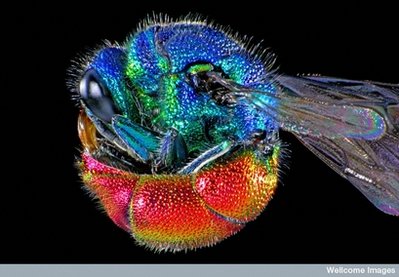
Colorful shots of a ruby-tailed wasp and a human chromosome bring mostly unseen objects to life.
Wellcome Image Awards 2011

Wellcome Images is world's leading source of ...

Wellcome Images is the world's leading source of images of medicine and its history. The Wellcome Image Awards recognize the creators of the most informative, striking and technically excellent images among recent acquisitions. You can view all of the 2011 winners at http://www.wellcomeimageawards.org/. This photomicrograph shows an adult ruby-tailed wasp curled into a ball. The wasp was lit with two electronic flashes while imaging to highlight the natural iridescent colours on its body.
Wellcome Image Awards 2011

Photomicrograph of a mosquito from the Culex ...

Photomicrograph of a mosquito from the Culex genus. This image shows the whole body of an adult male. The sample is from a microscope slide created in the middle of the 20th century.
Wellcome Image Awards 2011

Cell division and gene expression

Cell division and gene expression in plant cells. Confocal micrograph showing the expression of different fluorescent proteins in the stem of a thale cress seedling (Arabidopsis thaliana). Arabidopsis was the first plant to have its entire genome sequenced and is an important model for studying plant biology. The middle of the image shows a region of high cell proliferation, which drives the growth and branching of the seedling.
Wellcome Image Awards 2011

Polarised photomicrograph showing rows of suckers

Polarised photomicrograph showing the rows of suckers on the foreleg of a male diving beetle. Commonly known as the great diving beetle, these are largest freshwater beetles in the UK. They have a large streamlined body that is dark brown in colour, with a yellow abdomen and yellow legs. This image was produced by passing light through coloured filters, a technique known as Rheinberg illumination.
Wellcome Image Awards 2011

Cavefish embryo at around five days post-fertilisation. ...

Cavefish embryo at around five days post-fertilisation. The embryo has been stained with an antibody against a calcium-binding protein (in green) to show different neuronal types and their processes in the nervous system. This staining also reveals taste buds, which are located around the mouth and along the body of the cavefish.
Wellcome Image Awards 2011

Honey Bee - False colour scanning electron micrograph ...

Honey Bee - False colour scanning electron micrograph of a Honey bee. The honeybee has a hairy thorax and segented abdomen, a pair of double wings and three pairs of segmented legs, each one with a different 'tool', designed for a specific functions to assist in the collection and transport of pollen.
Wellcome Image Awards 2011

Image of human chromosome in metaphase

Image of a human chromosome in metaphase. The colours in this image indicate the density of chromatin in the chromosome, like a heat map (red shows high density, blue low). A low density of chromatin indicates a high level of gene expression, and a high density indicates repression of gene expression.
Wellcome Image Awards 2011

Moth wing scales

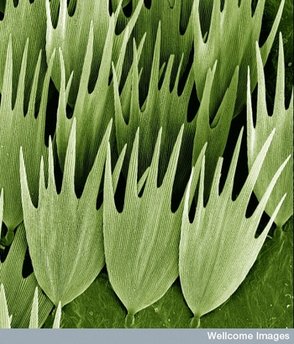
Moth wing scales. Scanning electron micrograph (SEM) of the scales on the wing of a Madagascan moon moth, Argema mittrei. This moth is also known as the Comet moth, after its very long tail. The tail span is 15 cm and wing span 20 cm, making it one of the world's largest silk moths.
Wellcome Image Awards 2011

This colour-enhanced photomicrograph shows different ...

This colour-enhanced photomicrograph shows different species of bacteria that cause dental plaque - a colourless film that forms on teeth caused by the growth of bacterial colonies. The sample was removed from the mouth of a patient diagnosed with an aggressive form of gum disease.
More aboutWellcome Image Awards 2011

Wellcome Image Awards 2011

Posted by Shazy

Wellcome Image Awards 2011

Striking microscope images nab awards

Colorful shots of a ruby-tailed wasp and a human chromosome bring mostly unseen objects to life.
Wellcome Image Awards 2011

Wellcome Images is world's leading source of ...

Wellcome Images is the world's leading source of images of medicine and its history. The Wellcome Image Awards recognize the creators of the most informative, striking and technically excellent images among recent acquisitions. You can view all of the 2011 winners at http://www.wellcomeimageawards.org/. This photomicrograph shows an adult ruby-tailed wasp curled into a ball. The wasp was lit with two electronic flashes while imaging to highlight the natural iridescent colours on its body.
Wellcome Image Awards 2011

Photomicrograph of a mosquito from the Culex ...

Photomicrograph of a mosquito from the Culex genus. This image shows the whole body of an adult male. The sample is from a microscope slide created in the middle of the 20th century.
Wellcome Image Awards 2011

Cell division and gene expression

Cell division and gene expression in plant cells. Confocal micrograph showing the expression of different fluorescent proteins in the stem of a thale cress seedling (Arabidopsis thaliana). Arabidopsis was the first plant to have its entire genome sequenced and is an important model for studying plant biology. The middle of the image shows a region of high cell proliferation, which drives the growth and branching of the seedling.
Wellcome Image Awards 2011

Polarised photomicrograph showing rows of suckers

Polarised photomicrograph showing the rows of suckers on the foreleg of a male diving beetle. Commonly known as the great diving beetle, these are largest freshwater beetles in the UK. They have a large streamlined body that is dark brown in colour, with a yellow abdomen and yellow legs. This image was produced by passing light through coloured filters, a technique known as Rheinberg illumination.
Wellcome Image Awards 2011

Cavefish embryo at around five days post-fertilisation. ...

Cavefish embryo at around five days post-fertilisation. The embryo has been stained with an antibody against a calcium-binding protein (in green) to show different neuronal types and their processes in the nervous system. This staining also reveals taste buds, which are located around the mouth and along the body of the cavefish.
Wellcome Image Awards 2011

Honey Bee - False colour scanning electron micrograph ...

Honey Bee - False colour scanning electron micrograph of a Honey bee. The honeybee has a hairy thorax and segented abdomen, a pair of double wings and three pairs of segmented legs, each one with a different 'tool', designed for a specific functions to assist in the collection and transport of pollen.
Wellcome Image Awards 2011

Image of human chromosome in metaphase

Image of a human chromosome in metaphase. The colours in this image indicate the density of chromatin in the chromosome, like a heat map (red shows high density, blue low). A low density of chromatin indicates a high level of gene expression, and a high density indicates repression of gene expression.
Wellcome Image Awards 2011

Moth wing scales

Moth wing scales. Scanning electron micrograph (SEM) of the scales on the wing of a Madagascan moon moth, Argema mittrei. This moth is also known as the Comet moth, after its very long tail. The tail span is 15 cm and wing span 20 cm, making it one of the world's largest silk moths.
Wellcome Image Awards 2011

This colour-enhanced photomicrograph shows different ...

This colour-enhanced photomicrograph shows different species of bacteria that cause dental plaque - a colourless film that forms on teeth caused by the growth of bacterial colonies. The sample was removed from the mouth of a patient diagnosed with an aggressive form of gum disease.
More aboutWellcome Image Awards 2011

Babies in Frontier States Have More Unusual Names

Posted by Shazy on Thursday, February 24, 2011

Babies in Frontier States Have More Unusual Names

Babies born in newer U.S. states have more distinctive names compared with their counterparts in older regions such as New England, a new study finds.
It turns out, the same values that pushed adventurous individuals into new territories as our country was being populated may still show up in the names their descendants give to babies, a new study finds.
In more recently established states, such as Washington and Oregon, parents tend to choose less common baby names, while parents in "older" areas, such as the original 13 states, go for more popular names.
Frontiers typically have fewer established institutions or infrastructure, and often occupy harsh environments. Early pioneers couldn't rely on others for help in such sparsely populated areas.These factors "select for people who are high in individualism and foster and reward individualistic values such as uniqueness and self-reliance," said lead researcher Michael Varnum of the University of Michigan. "This leads to regional cultures which perpetuate these values, which in turn shape behavioral practices, such as baby naming.
Psychologist Jean Twenge of San Diego State University, who studies baby naming, applauds Varnum's study on frontiers and unique baby names, which is detailed in the February 2011 issue of the journal Psychological Science.
"It's a really fascinating illustration of the impact of regional culture on naming choices," said Twenge, author of "The Narcissism Epidemic: Living in the Age of Entitlement" (Free Press, April 2009).
"Even though other people who came later may not have been so individualistic, that culture was set up," Twenge told LiveScience. "That legacy of the frontier is going to live on, and that shows up in baby names."
What names say about culture
The names we choose for our children do often reflect parents' values. "It's a very heartfelt choice and a noncommercial choice of what's important to us," said Laura Wattenberg, author of the book "The Baby Name Wizard" (Three Rivers Press, 2005) and creator of the website BabyNameWizard.com.
Wattenberg's  recent research showed that the meaning conveyed by a baby's name (what it tells others about the parents' tastes and background) has surged over the last 25 years as baby names have become more diverse and numerous.
"I'm convinced they're absolutely right in the core data that there's no question that the American frontier is a naming wonderland," Wattenberg told LiveScience. "Sarah Palin, even though she talks about traditional values, she's a perfect representative of frontier naming." Her kids are named Track, Willow, Trig, Bristol and Piper.
Even so, it's not simple to draw a causal connection between the character of a particular state and the naming conventions there. "Leaping from that to the idea that it represents the spirit of independence, I think there are a lot of other factors you need to consider when drawing that conclusion," Wattenberg said.
Baby names moving west
In the new study, Varnum and his University of Michigan colleague Shinobu Kitayama compared the commonness of popular baby names between relatively recently settled regions of the United States and older areas. The team used 2007 baby-name data collected by the Social Security Administration.
In New England states, more babies were given the most popular boys' and girls' names than they were in frontier states – those in the Mountain West and Pacific Northwest.
Statistical analyses showed the longer ago a state had achieved statehood, the more likely it was to have a higher percentage of people with one of the top 10 most popular baby names. The results held even after the researchers accounted for other factors that might impact baby-name choices, including population density, ethnicity of a state and median income.
The following is the study's ranked list of U.S. states where prevalence of common names is lowest (with No. 1 being the most individualistic), based on percentage of babies who had one of the top 10 most popular names of that year.
Boys' names:

  1. Hawaii
  2. Wyoming
  3. Louisiana
  4. Idaho
  5. Oklahoma
  6. Montana
  7. Colorado
  8. Nebraska
  9. Washington
  10.  Oregon
Girls' names

  1. Hawaii
  2. New Mexico
  3. Mississippi
  4. Nevada
  5. Georgia
  6. Wyoming
  7. Arizona
  8. Alaska
  9. Maryland
  10.  South Carolina
In contrast, these are the states where common names are most prevalent (with No. 1 being the least individualistic):
Boys' names

  1. New Hampshire
  2. Rhode Island
  3. Connecticut
  4. New Jersey
  5. Massachusetts
  6. West Virginia
  7. Maine
  8. New York
  9. Tennessee
  10.  Kentucky
Girls' names

  1. Maine
  2. Vermont
  3. New Hampshire
  4. Rhode Island
  5. West Virginia
  6. North Dakota
  7. Massachusetts
  8. Connecticut
  9. Kentucky
  10.  Iowa
The researchers found a similar naming phenomenon in Canada, where the country's eastern regions (which were settled earlier) — such as Nova Scotia, Ontario and Quebec — had a higher percentage of babies given popular names than the western, more recently settled regions, including Alberta, British Columbia, Manitoba and Saskatchewan.
However, the link was much stronger for boys' names than for girls', and after the researchers accounted for population density, the effect of eastern or western region on girls' names was negligible.
International study
To see if the same phenomenon held across entire nations, the team looked at baby-name data from 2007 for nine European countries (Austria, Denmark, England, Hungary, Ireland, Norway, Scotland, Spain and Sweden), and four frontier countries (Australia, Canada, New Zealand and the United States).
A similar pattern was found on this front as well, with the newer countries generally sporting more diverse names. In addition, countries that scored higher on an "individualism index" also had fewer babies who were given the most popular names at the time, compared with the countries that scored low on individualism.
But Wattenberg cautioned that the same factors may not be at work since some countries have rules for what parents can name their babies.
For instance, Denmark has a baby-naming rule list translated as the List over Personal Names. If a desired name is not on the list, a family can submit a written application to get consent from the Personal Names Committee under the auspices of the Danish Language Council. Names that aren't considered "personal names," including nicknames and "names, which can be feared to be a burden to the bearer," cannot expect to be approved, the committee states on its website.
Sweden, Hungary, Norway and other countries also have baby-naming laws.
"The idea of attributing a difference to some basic character when in fact, in one case, there are legal limits and in another case there aren't – they are not fundamentally comparable," Wattenberg told LiveScience.
Wattenberg said while she wasn't criticizing the study, she was pointing out that there could be other reasons behind some of the findings, particularly the international ones. For instance, she has found maternal age impacts baby names, where moms from urban, more affluent areas tend to choose more traditional names, which correlates with them waiting until they're older to have children.
More unique baby names now
Twenge said she saw a connection between her own work and the regional and demographic patterns in names found by Varnum.
Rather than looking at the popularity of common names across regions, Twenge studied the trend over time. It turns out, compared with decades ago, parents these days are choosing more unusual names for kids, which could suggest an emphasis on uniqueness and individualism.
Twenge's latest research, detailed in the January 2010 issue of the journal Social Psychological and Personality Science, revealed that about 40 percent of boys received one of the 10 most common names in the 1880s, while now fewer than 10 percent do. For girls, the percentage of those with a name in the top 10 dropped from 25 percent in about 1945 to 8 percent in 2007.
Read  More: Yahoo
More aboutBabies in Frontier States Have More Unusual Names

Babies in Frontier States Have More Unusual Names

Posted by Shazy

Babies in Frontier States Have More Unusual Names

Babies born in newer U.S. states have more distinctive names compared with their counterparts in older regions such as New England, a new study finds.
It turns out, the same values that pushed adventurous individuals into new territories as our country was being populated may still show up in the names their descendants give to babies, a new study finds.
In more recently established states, such as Washington and Oregon, parents tend to choose less common baby names, while parents in "older" areas, such as the original 13 states, go for more popular names.
Frontiers typically have fewer established institutions or infrastructure, and often occupy harsh environments. Early pioneers couldn't rely on others for help in such sparsely populated areas.

These factors "select for people who are high in individualism and foster and reward individualistic values such as uniqueness and self-reliance," said lead researcher Michael Varnum of the University of Michigan. "This leads to regional cultures which perpetuate these values, which in turn shape behavioral practices, such as baby naming.
Psychologist Jean Twenge of San Diego State University, who studies baby naming, applauds Varnum's study on frontiers and unique baby names, which is detailed in the February 2011 issue of the journal Psychological Science.
"It's a really fascinating illustration of the impact of regional culture on naming choices," said Twenge, author of "The Narcissism Epidemic: Living in the Age of Entitlement" (Free Press, April 2009).
"Even though other people who came later may not have been so individualistic, that culture was set up," Twenge told LiveScience. "That legacy of the frontier is going to live on, and that shows up in baby names."
What names say about culture
The names we choose for our children do often reflect parents' values. "It's a very heartfelt choice and a noncommercial choice of what's important to us," said Laura Wattenberg, author of the book "The Baby Name Wizard" (Three Rivers Press, 2005) and creator of the website BabyNameWizard.com.
Wattenberg's  recent research showed that the meaning conveyed by a baby's name (what it tells others about the parents' tastes and background) has surged over the last 25 years as baby names have become more diverse and numerous.
"I'm convinced they're absolutely right in the core data that there's no question that the American frontier is a naming wonderland," Wattenberg told LiveScience. "Sarah Palin, even though she talks about traditional values, she's a perfect representative of frontier naming." Her kids are named Track, Willow, Trig, Bristol and Piper.
Even so, it's not simple to draw a causal connection between the character of a particular state and the naming conventions there. "Leaping from that to the idea that it represents the spirit of independence, I think there are a lot of other factors you need to consider when drawing that conclusion," Wattenberg said.
Baby names moving west
In the new study, Varnum and his University of Michigan colleague Shinobu Kitayama compared the commonness of popular baby names between relatively recently settled regions of the United States and older areas. The team used 2007 baby-name data collected by the Social Security Administration.
In New England states, more babies were given the most popular boys' and girls' names than they were in frontier states – those in the Mountain West and Pacific Northwest.
Statistical analyses showed the longer ago a state had achieved statehood, the more likely it was to have a higher percentage of people with one of the top 10 most popular baby names. The results held even after the researchers accounted for other factors that might impact baby-name choices, including population density, ethnicity of a state and median income.
The following is the study's ranked list of U.S. states where prevalence of common names is lowest (with No. 1 being the most individualistic), based on percentage of babies who had one of the top 10 most popular names of that year.
Boys' names:

  1. Hawaii
  2. Wyoming
  3. Louisiana
  4. Idaho
  5. Oklahoma
  6. Montana
  7. Colorado
  8. Nebraska
  9. Washington
  10.  Oregon
Girls' names

  1. Hawaii
  2. New Mexico
  3. Mississippi
  4. Nevada
  5. Georgia
  6. Wyoming
  7. Arizona
  8. Alaska
  9. Maryland
  10.  South Carolina
In contrast, these are the states where common names are most prevalent (with No. 1 being the least individualistic):
Boys' names

  1. New Hampshire
  2. Rhode Island
  3. Connecticut
  4. New Jersey
  5. Massachusetts
  6. West Virginia
  7. Maine
  8. New York
  9. Tennessee
  10.  Kentucky
Girls' names

  1. Maine
  2. Vermont
  3. New Hampshire
  4. Rhode Island
  5. West Virginia
  6. North Dakota
  7. Massachusetts
  8. Connecticut
  9. Kentucky
  10.  Iowa
The researchers found a similar naming phenomenon in Canada, where the country's eastern regions (which were settled earlier) — such as Nova Scotia, Ontario and Quebec — had a higher percentage of babies given popular names than the western, more recently settled regions, including Alberta, British Columbia, Manitoba and Saskatchewan.
However, the link was much stronger for boys' names than for girls', and after the researchers accounted for population density, the effect of eastern or western region on girls' names was negligible.
International study
To see if the same phenomenon held across entire nations, the team looked at baby-name data from 2007 for nine European countries (Austria, Denmark, England, Hungary, Ireland, Norway, Scotland, Spain and Sweden), and four frontier countries (Australia, Canada, New Zealand and the United States).
A similar pattern was found on this front as well, with the newer countries generally sporting more diverse names. In addition, countries that scored higher on an "individualism index" also had fewer babies who were given the most popular names at the time, compared with the countries that scored low on individualism.
But Wattenberg cautioned that the same factors may not be at work since some countries have rules for what parents can name their babies.
For instance, Denmark has a baby-naming rule list translated as the List over Personal Names. If a desired name is not on the list, a family can submit a written application to get consent from the Personal Names Committee under the auspices of the Danish Language Council. Names that aren't considered "personal names," including nicknames and "names, which can be feared to be a burden to the bearer," cannot expect to be approved, the committee states on its website.
Sweden, Hungary, Norway and other countries also have baby-naming laws.
"The idea of attributing a difference to some basic character when in fact, in one case, there are legal limits and in another case there aren't – they are not fundamentally comparable," Wattenberg told LiveScience.
Wattenberg said while she wasn't criticizing the study, she was pointing out that there could be other reasons behind some of the findings, particularly the international ones. For instance, she has found maternal age impacts baby names, where moms from urban, more affluent areas tend to choose more traditional names, which correlates with them waiting until they're older to have children.
More unique baby names now
Twenge said she saw a connection between her own work and the regional and demographic patterns in names found by Varnum.
Rather than looking at the popularity of common names across regions, Twenge studied the trend over time. It turns out, compared with decades ago, parents these days are choosing more unusual names for kids, which could suggest an emphasis on uniqueness and individualism.
Twenge's latest research, detailed in the January 2010 issue of the journal Social Psychological and Personality Science, revealed that about 40 percent of boys received one of the 10 most common names in the 1880s, while now fewer than 10 percent do. For girls, the percentage of those with a name in the top 10 dropped from 25 percent in about 1945 to 8 percent in 2007.
Read  More: Yahoo
More aboutBabies in Frontier States Have More Unusual Names

5 Sneaky Things That Make You Look Older

Posted by Shazy on Thursday, February 17, 2011

After seeing pictures of Lindsay Lohan when she was sentenced to 90 days in jail plus rehab this past July, many people raised an eyebrow at her appearance. At just 24, she looked swollen, sallow, exhausted—older. Granted, the woman has had ha hard couple of years. But even those without addictions and ankle bracelets are at risk too. Many of us are so busy obsessing over little lines that we ignore other signs of aging that can be prevented or repaired with a few easy adjustments. So what could be wreaking havoc on your face? Here’s what to watch out for, along with no-brainer ways to turn back the clock.

A Dull Complexion

Sure, sure, by now you probably know that skipping your daily skin care routine can make you zitty, but can it also make you look older? Unfortunately, yes. “If you’re not cleansing your skin on a regular basis, dead skin cells start to accumulate on the surface,” says Diane Berson, M.D., assistant professor of dermatology at Weill Medical College at Cornell University. All those unsloughed cells block the work of moisturizers and anti-aging creams and make your skin look lackluster, according to Rolanda Johnson, Ph.D., senior scientist at Procter & Gamble Beauty. And if that’s not skeevy enough, “research has shown that free radicals in the environment can react with remaining dirt and oil to damage and age skin over time,” says Johnson.


Solution:

Take your skin care as seriously as your pedicure colors. “We cut corners, but we should be giving our skin as much attention as we give our other external features, like hair, nails and teeth,” says Jody Alpert Levine, M.D., a New York City dermatologist. If you don’t have time to wash your face in the morning, do at least a quick sweep of toner. And after a long day, “you definitely need to wash your face, whether you wore makeup or not,” says Dr. Levine. “There is always sebum produced and outside pollutants to wash off.” Don’t stop there: Gentle exfoliation a couple of times a week is a must for young, healthy skin. Elizabeth Tanzi, M.D., co-director of the Washington Institute of Dermatologic Laser Surgery in Washington, D.C., gives these guidelines to de-gunk pores: “For sensitive skin, just rub a wet washcloth over your face in a circular motion for a minute or two; a couple of times a week is enough. Oily skin types can use a glycolic exfoliator on a daily basis, and normal skin can use one up to three times a week.” Dr. Berson is a fan of electric cleansing brushes to mechanically exfoliate every day; try one with a bit of your favorite face wash.


Pesky Dark Spots

The most likely cause of brown spots is our good old friend and foe: the sun. UV rays can trigger an overproduction of melanin in the skin, and the effect on your appearance is every bit as aging as wrinkles. Shockingly, a 2009 study done on facial aging in identical twins found that different amounts of sun exposure made the more sun-damaged sibling look as much as 10 years older! “A lot of what we call aging is actually photo-aging from the sun,” says Dr. Berson. But first of all, what does a sunspot look like? Basically, it’s a big freckle that’s symmetrical and all one color, as opposed to skin cancers, which generally have asymmetry, irregular borders, color changes and a diameter larger than six millimeters, or about a quarter of an inch.

Solution:

Wear sunscreen, folks. “Some people think if the damage was done in their teens, Why bother with sunscreen now?” says Dr. Tanzi. “This is a serious mistake, because sun damage is cumulative—it’s never too late to regularly use an SPF of at least 30.”

And there are ways to deal with the damage you already have, too. “Once you’re in your thirties, everybody has some pigmentation that shows up from sun damage that happened before you were 18,” says Dr. Levine. “It’s easy to add a toner to your daily routine. Look for lightening agents like kojic acid, arbutin, emblica or hydroquinone, which can even out your skin tone.” Using a dark-spot treatment will do the trick too. Hyperpigmentation also frequently occurs in dark-skinned people in response to inflammation or hormones. These lighteners will tackle those spots, which can darken from sun exposure, says Dr. Levine. Just don’t forget to keep them in check with your daily dose of sunscreen.

Major Dryness

It’s no coincidence that the dude who represents the harshest season of the year is called Old Man Winter—chilly weather is brutal on the skin. The cold air and arid indoor heat break down your skin’s protective barrier, making it blotchy, flaky, older-seeming. “A youthful glow is all about luminosity,” says Dr. Levine. “Dry, rough, scaly skin stops light in its tracks.”

Solution:

For dewy, I-just-got-a-facial skin year-round, get a good moisturizer that’s right for you. “If you have normal to acne-prone skin, look for a light, noncomedogenic lotion,” says Dr. Tanzi. Oily skin types can get away with just swiping on serum. For those with super-dry complexions, Tanzi recommends rich hydrators with shea butter, petrolatum or dimethicone. And don’t forget to hydrate at night, too. Before bed, smear on an anti-aging night moisturizer to do double duty.

If you’re already religious about face cream (yay, you!) but still suffer from parched skin, your diet could be to blame. Overloading on carbohydrates and sweets can add years to skin’s appearance. “Excess sugar binds to proteins, which results in damage to elastin and collagen,” says Dr. Levine. “That makes your skin dry, brittle and less springy.” So instead of that third cupcake—we’re channeling your mother here—munch on skin-protecting antioxidants like those found in green tea, berries, and dark-colored vegetables such as kale, beets and broccoli.

Puffy Eye Bags

You might not experience these till your forties or beyond—but in this world, many women get them earlier, and they can make you look older than you are.

Solution:

Spending more time in the sack could help. “Chronic fatigue leads to overproduction of stress hormones, which creates an inflammatory response in your skin,” says Dr. Tanzi. “Getting at least seven hours of sleep a night would be fantastic. Two or three consecutive nights of good sleep can make a huge difference, but even one night is helpful.” The way you snooze also impacts puffiness. “If you sleep on your stomach or on your side, fluid can accumulate under the skin around the eyes,” says Dr. Berson. “Try to sleep on your back with your head elevated on an extra pillow to drain any excess.” It’s worth a shot—the more often you do it, the easier it is for gravity to work. A fix for morning emergencies: “Stick a wet washcloth in the freezer for 15 minutes, then use it as a cool compress,” says Dr. Tanzi. Another trick: Try an eye treatment with a roller ball applicator to help the product sink in deeper. It mimics the action of patting on cream with your finger, but does it faster.

Dark Circles

While your skin is doing the whole growing-old-gracefully thing, the under-eye area slowly darkens from a natural loss of fat stores. Eventually, that leads to hollowness and a shadowy effect. But in your twenties and thirties, dark circles can be attributed to three things: genetics, allergies or yo-yo dieting.

Solution:

First, rule out genetics. “Certain ethnicities, like those from India or the Middle East, have increased pigment under the eye,” says Dr. Tanzi. “In those cases, laser procedures can help, but they come with a recovery period of weeks or even months.” If genetics aren’t the issue, allergies may again be the culprit. If you have them, resist the urge to rub when your eyes get itchy. “Skin builds up pigment in response to rubbing,” says Dr. Levine. Minimize dark circles from allergies in the same way you’d treat under-eye bags—with cold compresses, antihistamines and allergen-reducing pillow covers.

Are none of the above scenarios sounding like you? Check your eating habits. Dark circles could be due to dramatic weight shifts from dieting. “Fat loss on the face can make you look drawn and older,” says Dr. Berson. Also, rapid weight gain or loss can have a bad impact on your skin overall, leading to a decrease in elasticity that ages you noticeably. The bottom line: Moderation is key. Keep weight loss to a sane pace of one to two pounds a week, cut back on late nights, curb your sweet tooth and stick with your daily skin care ritual, no matter how tired you are. Oh, and keep your driver’s license handy—these healthy habits just might get you carded.
Read More: Yahoo
More about5 Sneaky Things That Make You Look Older